


What Is Settlement and Why It Does It Matter?
Settlement is the process of transferring ownership of assets and payment from one party to another after a trade has been agreed.
It is the final step in the post-trade process, where risk is extinguished, and ownership changes hands.
In traditional finance, this normally involves exchanging securities and cash between two parties, typically using trusted intermediaries to ensure that delivery and payment happen securely and predictably.
This intermediary is typically a Central Securities Depository (CSD). The CSD registers the transfer legal title of securities from one party to another and coordinates the transfer of funds. The process is governed by strict legal frameworks to ensure finality: once settlement occurs and ownership has been registered, it cannot be reversed. Even if a party later becomes insolvent, transactions settled in a recognised settlement system cannot be undone.
Why Traditional Settlement Matters to Digital Assets
In digital asset markets, this function is often overlooked. Many platforms rely on atomic settlement via smart contracts or use custodians to handle off-chain transfers. But without a recognised intermediary providing settlement finality, legal certainty and systemic risk controls can be weak or absent.
In digital asset markets, the same principles apply, but the tools and technologies can differ. Some markets attempt to settle transactions peer-to-peer using blockchain protocols. However, as digital markets mature and attract institutional participants, the need for a trusted, centralized settlement process becomes clear. Central settlement reduces operational risk, enables netting, simplifies reconciliation, and ensures delivery and payment happen according to known standards.
Gross vs Net Settlement
How trade settlement occurs has a significant impact on liquidity, risk, and operational efficiency.
In many digital asset markets today, settlement is done on a gross basis. This means every individual trade results in a separate cash and asset transfer. For participants trading across multiple venues or at high frequency, this creates substantial friction:
- More payments: Each trade must be settled individually, increasing transaction volume.
- More prefunding: Cash or assets must be available in full for every trade at the time of settlement.
- More risk: Without coordinated timing, one side may deliver before receiving, creating settlement (principal) risk.
By contrast, net settlement allows trades and positions to be offset and aggregated, typically once per day or on a scheduled cycle. A central system calculates the net position for each participant, reducing the total number and value of settlements required.
For example:
- 50 buy trades and 40 sell trades in the same asset might net down to just 10 units owed and then settled in a single transaction.
This significantly reduces operational overhead, liquidity needs and the risk of failure or delay.
Net settlement is only possible with centralised coordination, such as via a central counterparty or central securities depository (CSD). It is the norm in traditional financial markets, and it is increasingly necessary to bring scalability and trust to digital asset settlement.
The Herstatt Crisis: Why Bilateral Trust Isn’t Enough
In 1974, the collapse of a small German bank, Herstatt, sent shockwaves through global markets. The bank failed after receiving Deutsche Marks from counterparties — but before it delivered US dollars in return. The time zone gap created a fatal exposure. Banks lost millions, confidence collapsed, and regulators realised a hard truth: bilateral trust alone cannot guarantee completion.
The crisis led to the creation of new institutions and reforms designed to remove settlement risk and guarantee trade completion through central clearing.
Digital asset markets today echo the pre-Herstatt era. Most trades remain bilateral, with no central party to guarantee completion. If one side fails, the other bears the loss. This structure is vulnerable to disruption during market stress.
Just as Herstatt reshaped traditional markets, the next phase of digital markets depends on centralised clearing to mutualise risk, reduce exposure, and ensure that trades actually settle, even if a counterparty defaults.
Core Functions of Modern Settlement Systems
There are two key aspects to net settlement:
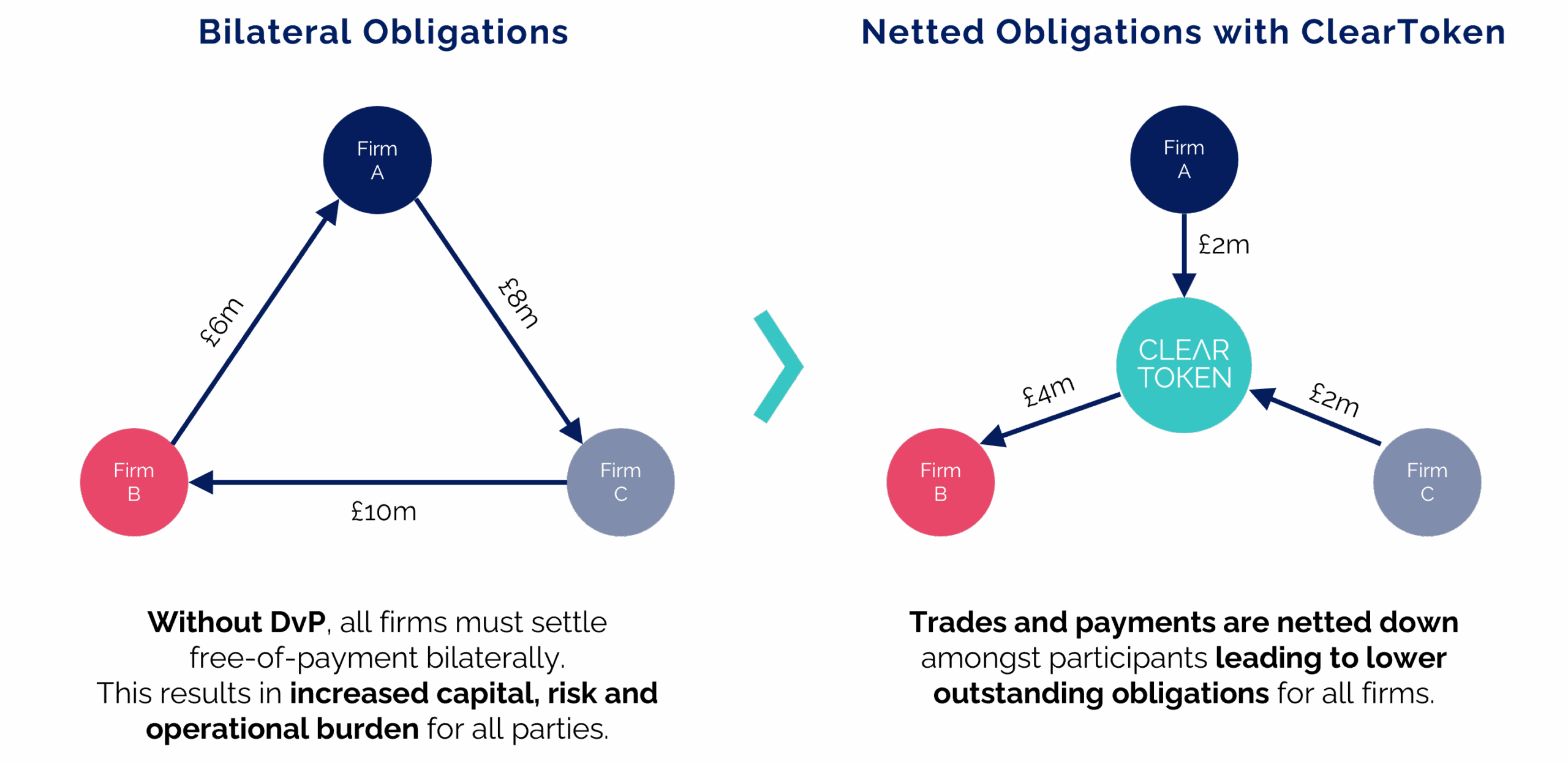
ClearToken offsets settlement obligations across all participants to determine a single net amount to pay or receive.
Settlement-level netting minimises the actual number of asset and cash transfers required for each settlement cycle, simplifying obligations and reducing friction and complexity across the market.
This dramatically reduces exposure, operational complexity and settlement volume.
Rather than settling every trade separately, ClearToken nets all settlement obligations across all CCPs (ClearToken stands to be the first for digital assets), bilateral OTC participants and trading venues within our network. For example,
- Participant A owes 100 BTC through ClearToken CCP
- Participant A is owed 300 BTC through an OTC platform
- ClearToken nets these positions, resulting in a single obligation to deliver 200 BTC to Participant A.
By reducing the number of transfers, netting enhances capital efficiency and lowers the risk of payment delays during periods of market stress.
Delivery vs Payment (DvP) settlement, the simultaneous exchange of cash and assets, is a core pillar of trusted market infrastructure.
ClearToken brings this model to digital assets, ensuring settlement only occurs when both parties have fulfilled their obligations. Many transactions in digital assets take place without any means for cash and assets to be delivered simultaneously and risk is associated with every individual transaction, and as we explain in our white paper, “simultaneous settlement instructions does not mean simultaneous settlement is achieved”.
Following the netting process in a settlement cycle, ClearToken informs each participant what cash and assets are requires for settlement. Once received, ClearToken simultaneously executes delivery, eliminating settlement risk. By intermediating settlement, ClearToken resolves settlement risks issues currently present in digital asset markets, for example, cross-chain bridge vulnerabilities, network delays, hacks, chain reorganisations, lack of accountability etc.
Crucially, our service is designed to meet institutional and regulatory standards. By leveraging our DvP settlement service, participants can confidently engage in digital asset markets with the security and efficiency expected in traditional financial markets.
Subject to regulatory approval, ClearToken will soon bring the efficiency and reliability of net DvP settlement to digital assets.
Together, netting and DvP form the foundation of our settlement service; delivering the risk reduction, capital efficiency and post-trade certainty that institutional markets expect, and digital innovators are now ready for.
The Impact of DvP Net Settlement





Applying These Principles to Digital Assets
As digital asset markets evolve, participants are increasingly adopting institutional trading patterns, executing high volumes across multiple venues, with tighter risk controls and growing regulatory expectations. However, the underlying settlement infrastructure often lags behind.
In many digital markets today:
- Settlement is attempted on-chain, but depends on protocol-level logic and peer-to-peer interactions.
- There is no consistent finality framework; confirmation does not mean legal settlement.
- Delivery and payment are not always synchronised, leaving parties exposed to settlement (principal) risk.
- Even when positions are netted down bilaterally, there is no coordination of timing; each obligation must be settled separately and immediately, increasing the burden on liquidity.
To align with institutional standards, digital markets need trusted infrastructure that provides:
- Definitive finality: backed by law, not just code.
- Central settlement coordination: allowing for batching, timing control, and reduced friction.
- Netting capabilities: to reduce the liquidity and operational overhead of gross settlement.
- Delivery-versus-payment (DvP): ensuring that asset and payment move together.
These are the same principles that underpin trusted settlement in traditional finance. Applying them to digital assets ensures that markets can scale securely — unlocking efficiency without compromising trust.
Learn about our digital clearing and settlement services.
Dive into our thought leadership white papers and articles.
Catch up on our latest news and press coverage.